Executive Key Takeaways
- Ladle travel distance from furnace to pouring lines must be strictly minimized to prevent temperature loss and molten splash risks.
- Thermal zoning requires physical structural barrier walls between furnace bays and manual fettling/finishing shops.
- Crane rail heights and bay clear heights must accommodate high-capacity EOT cranes (up to 30 MT) with clear overhead maintenance envelopes.
- Sand plant recycling requires dedicated vertical tower structures and underground conveyor return trenches.
- Layered HT electrical redundancy is paramount to prevent molten metal solidification during sudden grid failures.
Foundry facilities represent one of the most demanding environments in industrial engineering. Molten metal above 1500°C must be handled with absolute safety, while heavy raw materials (scrap, pig iron, ferroalloys, silica sand) circulate continuously alongside intensive heat, dust, and toxic fumes.
A poorly planned foundry layout introduces catastrophic safety hazards, excessive ladle travel times resulting in thermal loss, dust contamination in clean core rooms, and chronic structural fatigue on crane runway girders.
Core Engineering Challenges in Foundry Planning
A foundry transforms scrap metal and ingots into precision castings through thermal melting, sand moulding, pouring, cooling, shakeout, and surface fettling. Unlike light engineering plants, foundries experience extreme thermal gradients, heavy abrasive airborne dust, and severe dynamic crane impacts.
The engineering challenge is twofold: creating a continuous, unidirectional material flow while erecting robust physical, thermal, and atmospheric barriers between hostile melting zones and precision machining/finishing spaces.
Process Flow Architecture: Unidirectional Logistics
The golden rule of foundry architecture is unidirectional material progression. Raw scrap enters the scrap yard, moves into melting furnaces, pours into moulds, travels through cooling tunnels to shakeout, and exits via fettling and dispatch without ever backtracking.
Scrap Yard & Charge Prep
Covered scrap yard with magnet cranes, weigh hoppers, and pre-heaters.
Induction Melting Bay
Dual-track induction melting and holding furnaces with primary ladle transfer.
Core Making & Sand Plant
Temperature-controlled core shop and automated green sand preparation plant.
Pouring & Cooling Track
Automated or semi-automated flask pouring line with dedicated cooling loop.
Shakeout & Casting Cleaning
Vibratory shakeout, shot blasting, riser cutting, and grinding/fettling.
Heat Treatment & Dispatch
Normalizing/annealing furnaces, dimensional inspection, and shipping.
Melting & Holding Furnace Zoning and Crane Integration
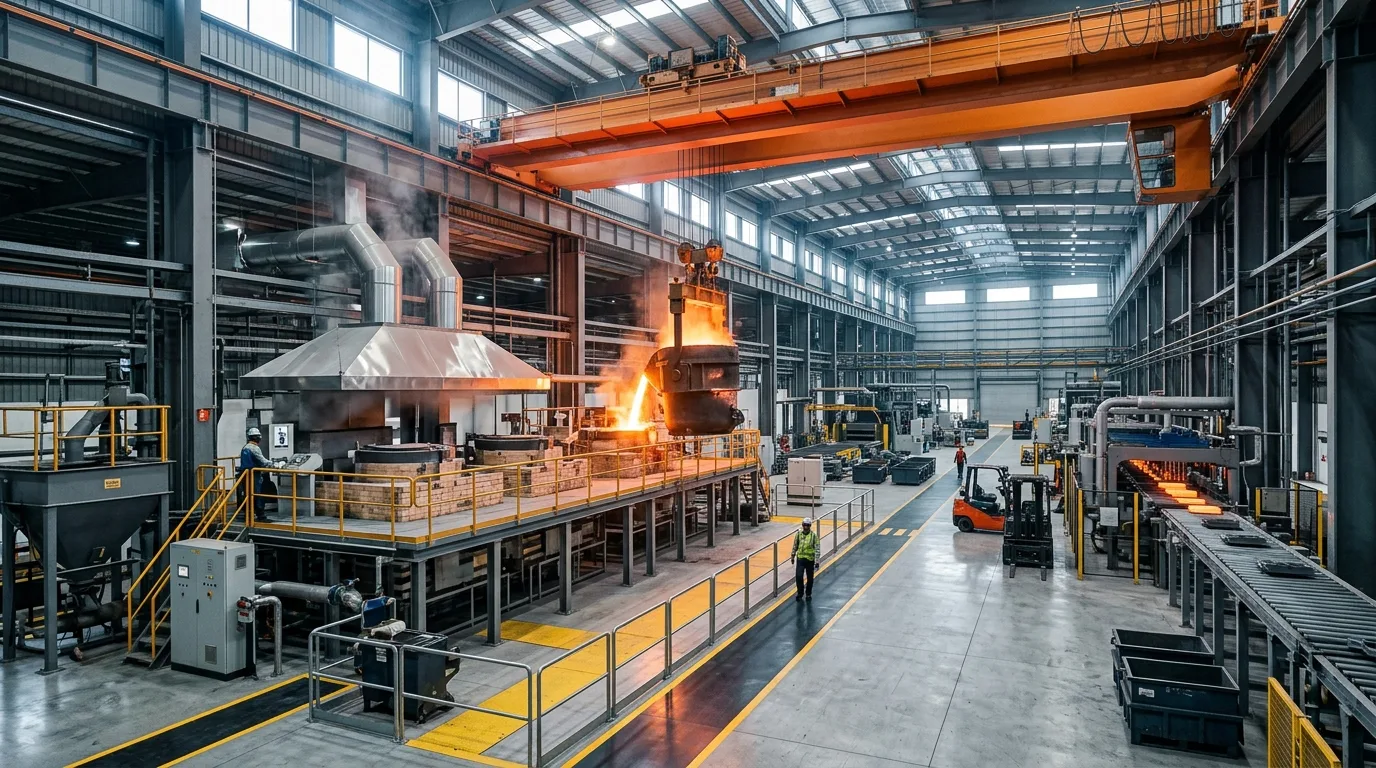
The melting platform is the highest-risk zone in the facility. It must be positioned adjacent to incoming HT electrical substations to minimize heavy secondary busbar runs. The elevated charging platform requires structural steel design to sustain concentrated scrap bin drop impacts.
EOT cranes must be segregated: high-speed magnet cranes handle incoming scrap in the yard, while dedicated ladle cranes (equipped with heat-shield cabs and fail-safe dual braking systems) operate along the furnace pouring aisle. Crane rail levels must maintain at least 3.0m clearance above furnace tilt arcs.
Sand Preparation Tower & Temperature-Controlled Core Shop
The sand preparation plant is inherently vertical. Sizing the sand plant tower requires structural coordination for multi-tier sand silos, batch mullers, aerators, and magnetic separators. Underground return sand conveyor trenches must be waterproofed and easily accessible for routine maintenance.
In contrast, cold-box and shell core rooms must be completely segregated from foundry dust and ambient humidity. Core shops require positive-pressure air filtration and dedicated resin/catalyst storage adhering to hazardous chemical safety protocols.
Moulding, Pouring & In-Line Cooling Infrastructure
Whether utilizing high-pressure flaskless green sand moulding lines (e.g. Disamatic) or no-bake continuous mixers, the pouring station requires an unobstructed straight-line ladle transit. Emergency spill pits lined with dry refractory sand must be positioned below pouring stations to contain accidental liquid metal runouts safely.
Cooling conveyor lengths must be calculated based on maximum casting section thickness to ensure castings cool below critical oxidation temperatures before hitting the vibratory shakeout.
Shakeout, Shot Blasting & Fettling Shop Organization
The shakeout station produces extreme noise, vibration, and dust. It must be housed in an acoustically and structurally dampened foundation enclosure fitted with high-velocity canopy exhaust hoods. Vibration isolation joints prevent dynamic shocks from transmitting into adjacent precision plant foundations.
Fettling, riser cutoff, and grinding operations require dedicated downdraft grinding tables, booth dust collection systems, and wide 4-meter forklift transit aisles for containerized casting bins.
Ventilation, Fume Extraction & Environmental Compliance
Foundry buildings require high natural ventilation rates combined with engineered pulse-jet baghouse filtration systems. High-pitched roof monitors with deep louvers utilize natural thermal stack effects to exhaust hot process air.
Melting furnaces must be equipped with side-draft or ring hoods capturing emissions during charging, melting, and slag removal, ducting dirty air directly into bag filter houses to comply with strict CPCB emission standards (<30 mg/Nm3 particulate matter).
HT Electrical Power Architecture & Redundancy
Medium-frequency induction furnaces demand immense electrical power—often 2,000 to 10,000 kVA. The incoming 11 kV or 33 kV substation must feature two independent transformer feeds with automatic changeover switches.
Emergency diesel generation must be sized to support furnace coil cooling water pumps and hydraulic tilt systems indefinitely. A loss of cooling water to a furnace coil mid-melt can cause water leaks, catastrophic molten metal explosions, or total coil burnout.
Critical Mistakes to Avoid in Facility Planning
1. Long ladle transfer distances across main walkways
Causes liquid metal cooling, increases crane cycle times, and exposes plant personnel to spill risks.
2. Placing core making shops adjacent to the shakeout area
Abrasive airborne sand and dust ruin delicate core surfaces and degrade binder curing chemistry.
3. Inadequate crane runway girder fatigue analysis
Heavy, continuous ladle crane duty cycles cause fatigue cracking in light structural building columns.
4. Lack of emergency molten metal spill pits
Runouts from compromised furnace linings spread across the floor, damaging hydraulic lines and cables.
5. Neglecting underground sand trench waterproofing
Groundwater ingress turns sand trenches into slurry pits, causing total conveyor failure.
Safe, High-Tonnage Casting Demands Disciplined Foundry Engineering
In a modern foundry, every meter of unnecessary travel represents wasted energy, increased cycle time, and heightened safety exposure.
Our engineering team at Vishwakalpa brings real-world project experience—such as our 4,00,000 sq ft Grinding Media Foundry Campus in Ahmedabad—to design resilient, high-output casting campuses.
Frequently Asked Questions
What is the most critical factor in foundry layout planning?
Minimizing molten metal transfer distance and establishing strict physical separation between hazardous melting operations and worker-intensive finishing and core-making areas.
How much clear height is needed in an industrial foundry shed?
Foundry melting and pouring bays typically require a minimum clear eave height of 12.0m to 16.0m, with crane rails positioned at 8.0m to 11.0m to accommodate crane cabs, hooks, and furnace tilting envelopes.
How do you control heat and fumes in a foundry?
Through a combination of localized source-capture hoods (ducted to pulse-jet baghouses) and high-volume natural stack ventilation utilizing roof ridge monitors and louvered wall intakes providing 25-40 air changes per hour.
Can Vishwakalpa assist with turnkey foundry project management?
Yes. Vishwakalpa provides comprehensive foundry master planning, structural crane bay engineering, furnace MEP coordination, environmental pollution NOC layouts, and full PMC supervision.

Explore More Technical Guides
Precision Machining Unit Design Guide
12 min read
CNC Machining Plant Layout Planning Guide
14 min read
CNC Plant Space Requirement Calculation Guide
15 min read
What Is Industrial Architecture?
10 min read
Plant Expansion Readiness Guide
11 min read